
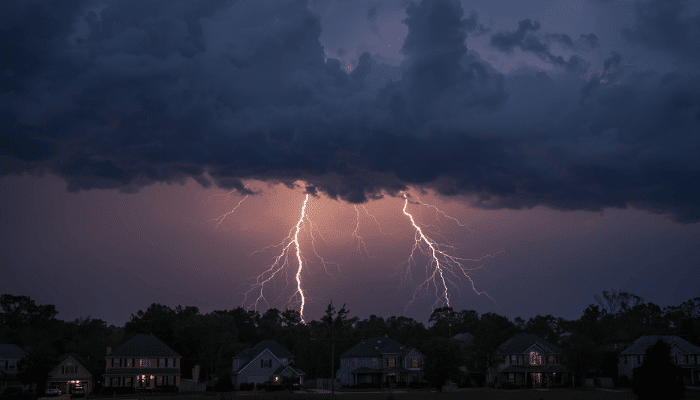
One bad afternoon storm can take out your AC, your fridge, and half your electronics — here's how to stop it before it ever reaches the outlet
If you've made it through a few Georgia summers, you know the pattern by heart. The morning starts clear and sticky, the clouds pile up through the afternoon, and by four or five o'clock the sky opens up with one of those thunderstorms that rattles the windows and lights up the whole house. We get plenty of them around Cartersville. Most roll through in twenty minutes and leave nothing behind but a wet driveway.
But every now and then, one of those storms leaves a mark you don't notice until later. The AC won't kick back on. The refrigerator hums but never cools. The TV powers up to a black screen. And the strange part? Lightning never actually hit your house.
What got you was a power surge — and it's one of the most overlooked threats to everything you've plugged in. The good news is that a whole-home surge protector can stop most of that damage right at your electrical panel, long before it reaches the devices you actually care about. Let's break down how surges happen, why the power strip behind your TV isn't going to save you, and what real protection looks like.
What a power surge actually is
Your home's wiring is built to carry electricity at a steady, predictable level. A surge is a sudden spike above that level — sometimes for just a fraction of a second. When that extra voltage shows up, it has to go somewhere, and it ends up burning through the sensitive components inside whatever's connected at the time.
Lightning gets all the headlines, and for good reason. A strike doesn't have to hit your roof to hurt you. One that lands on a power line down the street, or even on a transformer a mile away, can send a massive jolt straight into the lines feeding your neighborhood. By the time it reaches your panel, it's still more than enough to fry electronics in an instant.
Here's what surprises most homeowners, though: lightning isn't even the most common cause. The bigger appliances in your home — your air conditioner, well pump, refrigerator, dryer — kick small surges back into your wiring every time they cycle on and off. You never see them, but they're happening all day, every day. A single storm surge can kill a device on the spot. The constant small ones quietly wear your electronics down until they fail years early. Both are doing real damage.
Why power strips aren't enough
A lot of people assume the surge protector strip behind the entertainment center has them covered. It doesn't — not on its own.
Those plug-in strips are what the industry calls point-of-use protection. They're useful, but they're the last line of defense, and they only guard whatever's plugged directly into them. They also tend to have a much smaller capacity, which means a big storm surge can blow right past them. And once a power strip absorbs a serious hit, it's often spent — it'll keep passing power through while no longer protecting anything, with no obvious sign it's failed.
Meanwhile, your most expensive equipment usually isn't on a power strip at all. Your HVAC system, your oven, your water heater, your dishwasher — all of it is hardwired or plugged straight into the wall, completely exposed.
How whole-home surge protection works
A whole-home surge protector solves that problem at the source. Instead of guarding one outlet, it's installed right at your electrical panel, so it stands between the incoming power and everything in your house.
When a surge tries to push through, the device catches the excess voltage and safely diverts it to ground before it can spread through your circuits. It works fast — far faster than you'd ever react to a flickering light — and it covers the whole home at once, hardwired appliances included. Think of it as the first and biggest line of defense, the one that takes the brunt of a storm hit so your electronics never feel it.
It's not a do-it-yourself job, either. A surge protector ties directly into your panel and has to be sized and installed correctly to do its job safely, which is exactly the kind of work a licensed electrician should handle.
What it actually protects
Step back and look at how much of a modern home runs on electronics, and the value gets obvious in a hurry. Your HVAC system has circuit boards in it now. So does your refrigerator, your washer, your oven, and your garage door opener. Add in everything that's purely electronic — TVs, computers, gaming consoles, smart thermostats, cameras, your whole smart-home setup — and the replacement cost of one bad surge adds up fast. If you've installed an EV charger or a backup generator, those deserve protection too.
For most homeowners, a whole-home surge protector costs a small fraction of what it would cost to replace a single fried HVAC unit or refrigerator. It's one of those upgrades that quietly pays for itself the first time a storm rolls through and your house just... keeps working.
The best setup uses layers
Here's the honest answer an electrician will give you: the strongest protection comes from combining both approaches. The whole-home unit at your panel knocks down the big surges from the grid and from lightning. Then quality point-of-use protectors on your most sensitive electronics catch the smaller stuff that slips through. Together they cover what neither can handle alone — and that's the setup we recommend for homes around Cartersville and across Bartow County, where summer storms are simply part of the deal.
Don't wait for the next storm to find out you weren't protected
Surge protection is one of those upgrades nobody thinks about until the day after they need it. The far better time to install one is before the next round of afternoon thunderstorms rolls in.
At 1 Best Electric, we install whole-home surge protection quickly, correctly, and to code — and we're happy to walk you through your options and what makes sense for your home. We're local, family owned, and fully licensed, with a 5.0 rating from your neighbors across the area.
Call us today at 470-309-6996 or request service online, and protect everything you've plugged in before the next storm does it for you.