
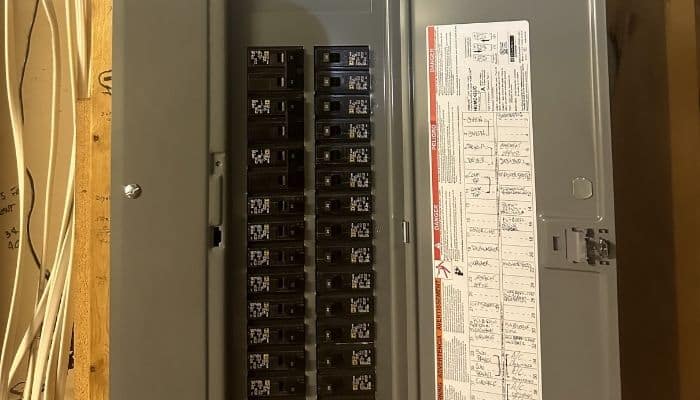
Most homeowners know where their breaker panel is. Usually it's tucked in a hallway, a utility room, a garage, or a basement. You've probably opened it once or twice, flipped a tripped breaker back on, and closed it up without thinking much about it.
But your breaker panel is actually one of the most important safety systems in your home, and knowing how to read it can help you catch problems early, troubleshoot minor issues yourself, and know when it's time to call a licensed electrician.
Here's what you need to know.
What Is a Breaker Panel and What Does It Do?
Your breaker panel, sometimes called an electrical panel, load center, or fuse box in older homes, is the central distribution point for all the electricity in your house. Power comes in from the utility company, passes through your main breaker, and then splits out into individual circuits that run to every outlet, light, and appliance in your home.
Each circuit has its own breaker. When a circuit gets overloaded or a fault occurs, the breaker trips and cuts power to that circuit. That's a safety feature, not a flaw. It's the panel doing exactly what it's supposed to do.
The Parts of Your Breaker Panel
When you open your panel door, here's what you're looking at:
The Main Breaker
This is the large breaker at the top of the panel, usually rated for 100, 150, or 200 amps. It controls power to your entire home. If you ever need to shut off all electricity quickly, this is the switch.
The Circuit Breakers
These are the rows of smaller breakers below the main. Each one controls a specific circuit in your home, such as the kitchen outlets, the master bedroom, the HVAC system, or the garage. Most are either 15 or 20 amps for standard circuits, with larger double-pole breakers handling big appliances like your dryer, water heater, or air conditioner.
The Circuit Directory
This is the label on the inside of the panel door that tells you which breaker controls which area of your home. In a well-maintained panel, every slot is labeled clearly. In a lot of older homes, these labels are missing, wrong, or written in handwriting nobody can read anymore.
The Bus Bars
These are the metal strips running down the center of the panel that the breakers clip onto. You probably won't focus on these, but they're worth knowing exist.
Neutral and Ground Bars
These are the rows of screws along the sides of the panel where white and bare copper wires terminate. They complete the circuit and provide a safe path for fault current.
How to Tell If a Breaker Has Tripped
A tripped breaker sits in a middle position between on and off. It won't be fully flipped to the off side, and it won't look fully on either. Some panels have breakers with a small orange or red indicator window that appears when a breaker has tripped, which makes it easier to spot at a glance.
To reset a tripped breaker, switch it fully to the off position first, then flip it back to on. If it trips again immediately or won't stay on, that's a sign of an underlying problem that needs to be looked at.
What a Healthy Panel Looks Like
A panel in good shape will have a few things going for you:
- Every breaker is clearly labeled and corresponds to the right circuit
- No breakers are in a tripped or halfway position
- There are no burn marks, scorch stains, or discoloration anywhere inside the panel
- There's no burning smell or unusual odor when you open the door
- Wiring is organized and nothing looks melted, frayed, or jury-rigged
- There's no rust or moisture inside the box
- The panel has open slots available if you ever need to add circuits
Warning Signs That Something Is Wrong
This is where it pays to know what you're looking at. These are the things that should prompt a call to a licensed electrician.
Breakers That Keep Tripping
An occasional tripped breaker is normal. A breaker that trips repeatedly on the same circuit is telling you something. Either that circuit is consistently overloaded, or there's a wiring fault that needs to be found.
A Breaker That Won't Reset
If you flip it off and back on and it immediately trips again, don't keep trying. There's a reason it's tripping and forcing it isn't the answer.
Burning Smell or Scorch Marks
This is serious. A burning smell near your panel, or any visible scorching or discoloration on the breakers or wiring, means heat is building up somewhere it shouldn't be. This is a fire hazard and needs immediate attention.
Buzzing or Crackling Sounds
A properly functioning panel is silent. Any buzzing, crackling, or humming coming from inside the box is a red flag.
Rust or Moisture Inside the Panel
Water and electricity are a dangerous combination. If your panel shows any signs of moisture intrusion or rust, it needs to be inspected right away.
Your Panel Still Has Fuses
If you open your panel and see glass screw-in fuses instead of breakers, your home has older electrical infrastructure that may not meet current safety standards. This doesn't mean it's immediately dangerous, but it does mean an evaluation is overdue.
Handwritten Labels, Missing Labels, or Labels That Don't Match
This one won't cause a fire on its own, but it's a sign the panel hasn't been properly maintained. If you don't know what controls what, you can't respond quickly in an emergency.
What You Can Handle Yourself vs. When to Call an Electrician
You can safely:
- Reset a tripped breaker
- Check the circuit directory to identify which breaker controls a given area
- Turn off the main breaker in an emergency
Call a licensed electrician if:
- A breaker keeps tripping or won't stay reset
- You notice burning smells, scorch marks, or sounds coming from the panel
- You want to add a new circuit or increase your service capacity
- Your panel is more than 25 to 30 years old and has never been evaluated
- You're adding an EV charger, generator, or major appliance and aren't sure your panel can handle the load
- You have any doubt at all about what you're looking at
Electrical panels are one of those things where the cost of getting it wrong is too high to guess. If something looks off, it's always worth a phone call.
Your breaker panel doesn't ask for much attention. But when it does start signaling a problem, knowing what to look for puts you in a much better position to respond quickly and safely. A quick visual check every few months, keeping the directory up to date, and not ignoring repeated tripping are simple habits that go a long way.
And if you open that panel door and something doesn't look right, don't wait on it. Give us a call at 470-309-6996 and we'll take a look.