
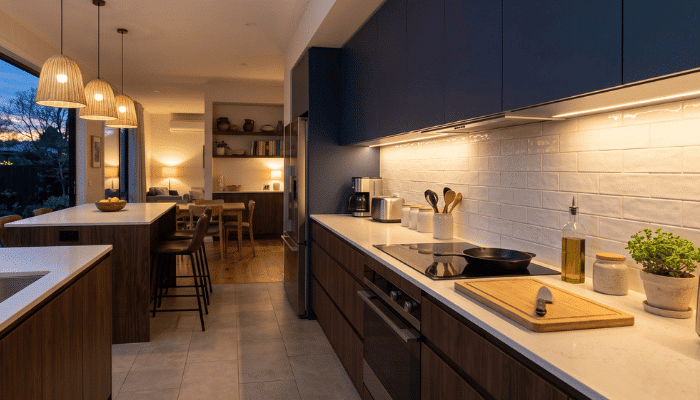
Ask a homeowner what is wrong with their kitchen lighting and you usually get the same answer: it is fine until you actually try to do something. You chop vegetables in your own shadow. The far corner of the counter stays dim no matter what. One big fixture in the middle of the ceiling lights the room but not the work.
The fix is almost never a bigger bulb. It is better layers.
Good kitchen lighting is built in three layers that each do a different job. When you get all three working together, the room feels brighter, looks more finished, and is a lot easier to cook and live in. Here is how the layers work and where under-cabinet and task lighting fit in.
The three layers of kitchen lighting
Ambient lighting is your base layer, the general light that fills the room. This is usually your ceiling light or a set of recessed lights spaced across the ceiling. Ambient light lets you walk in and see the whole space, but on its own it leaves shadows exactly where you work.
Task lighting is focused light aimed at the surfaces where you actually do things: countertops, the stove, the sink, and the island. This is the layer most kitchens are missing, and it is the one that makes the biggest day-to-day difference. Under-cabinet lighting is the classic example.
Accent lighting is the finishing layer. Think of a light inside a glass-front cabinet, a strip above the cabinets washing the ceiling, or a fixture that highlights a backsplash. Accent light does not help you work. It sets the mood and makes the kitchen feel designed instead of just lit.
Why under-cabinet lighting is worth it
Your upper cabinets throw a shadow straight down onto the counter below them. That is the exact spot where you prep food, read a recipe, and use small appliances. Overhead light cannot reach it because your own body and the cabinets block the way.
Under-cabinet lighting solves that by putting the light where the work is. Mounted underneath the upper cabinets and aimed at the counter, it removes the shadow completely. A few things we point out to homeowners in Cartersville and across Northwest Georgia:
- LED strip or linear fixtures give the most even light. They run the length of the cabinet with no dark gaps, unlike older puck lights that leave bright and dim spots.
- Warm-white light usually flatters a kitchen best. Somewhere in the soft-white range keeps food and finishes looking natural instead of blue.
- Hardwired beats plug-in for a clean look. Plug-in strips work in a pinch, but you end up with visible cords and a used outlet. Hardwired under-cabinet lighting is run inside the wall and controlled by a switch, which looks built-in because it is.
That last point is where a licensed electrician matters. Running the wiring cleanly, tying it to a switch, and keeping everything to code is what separates a finished kitchen from a DIY project with a cord taped to the underside of a cabinet.
Task lighting beyond the cabinets
Under-cabinet lighting handles the counters, but a full kitchen has other work zones that deserve their own light:
- Over the sink. A dedicated fixture or recessed light over the sink keeps dishes and food prep out of the shadows.
- Over the island. Pendants or recessed lights turn an island into a real prep and homework surface instead of a dim table in the middle of the room.
- Inside the pantry. A simple switched light inside the pantry beats squinting into a dark closet, and it is an easy add during a lighting project.
A note on switches and dimmers
Layers are only useful if you can control them separately. The goal is to run the ambient, task, and accent layers on their own switches so you can turn the room all the way up when you are cooking and dial it down for dinner. Dimmers make this even better, but they have to be matched to your LED fixtures. The wrong dimmer is one of the most common reasons LED lights buzz or flicker, so it is worth getting right the first time.
If your whole kitchen is still running older bulbs, a lighting project is also the natural time to think about whether it is time to upgrade to LED across the room while the electrician is already there.
Let us light your kitchen the right way
A well-lit kitchen is one of the highest-value, most noticeable upgrades you can make to a home, and it is one of the things we do best. Our licensed electricians handle the whole job, from planning the layers to running clean, code-compliant wiring for indoor lighting installation that looks like it was always there.
If you are in Cartersville, Acworth, Canton, or anywhere across Bartow County and Northwest Georgia, we would love to help you plan it. Call 470-309-6996 or reach out online to get started.
It should have its own control so you can use your task lighting without turning on every light in the room. Most installations put it on a dedicated wall switch, and it can be paired with a compatible dimmer.
Yes. In most kitchens our electricians can add hardwired under-cabinet lighting without a full remodel by running the wiring behind the cabinets and into the wall.
Warm-white to soft-white light tends to look best in a kitchen because it keeps food, countertops, and cabinet finishes looking natural. Very cool, blue-tinted light can feel harsh in a home kitchen.