
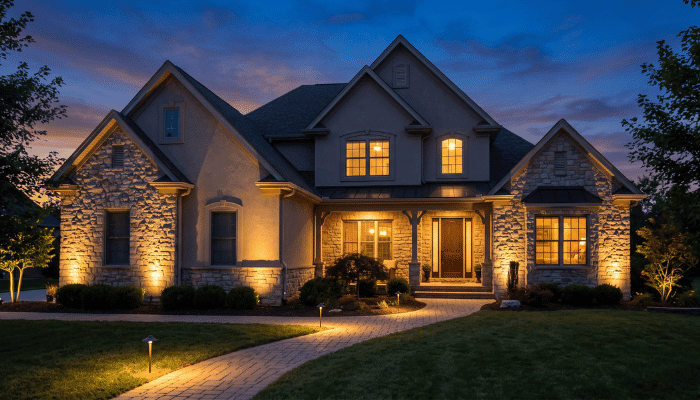
The right landscape lighting does something no other outdoor upgrade can. It makes your home look better after dark than it does in daylight. A house that disappears into the yard at sunset becomes a warm, welcoming, secure-looking property with a few well-placed lights.
The trick is that good landscape lighting is designed, not just installed. Sticking a few fixtures in the ground and pointing them up gives you glare and dark spots. A little planning gives you depth, safety, and curb appeal that lasts all year. Here are the basics every homeowner should know before lighting up the yard.
Start with a job for each light
Before picking fixtures, decide what each light is supposed to do. Almost every landscape lighting plan comes down to three goals:
- Safety and wayfinding. Lighting the paths, steps, and driveway so people can move around after dark without tripping.
- Beauty and curb appeal. Highlighting the trees, the front of the house, and the features you are proud of.
- Security. Removing the dark corners where you would rather not have surprises, especially now that it gets dark earlier in the evening.
When you know the job, the technique picks itself.
The core landscape lighting techniques
Path lighting uses short fixtures spaced along walkways, garden beds, and driveways. The goal is a gentle, even pool of light on the ground, not a runway. Well-spaced path lights guide people safely and outline the shape of your yard at night.
Uplighting places a fixture at the base of a tree, column, or wall and aims it upward. This is what gives a yard drama. Uplighting a mature oak or the corners of your home creates shadow and height that flat overhead light never will.
Downlighting, sometimes called moonlighting, does the opposite. A fixture mounted high in a tree or on the house casts a soft light down through the branches, mimicking natural moonlight. It is subtle and beautiful over patios and walkways.
Wall washing and grazing aim light across a flat surface like a stone wall or a textured facade. Washing gives an even glow. Grazing sits the light close to the surface to bring out texture.
Accent and feature lighting picks out the specific things worth showing off: a water feature, a garden bed, a flag, a sign, or an entryway.
Most great-looking yards use two or three of these together. A common front-yard recipe is path lights along the walk, uplights on the two front corners of the house, and a couple of uplights on a favorite tree.
Why most landscape lighting is low-voltage
Modern residential landscape lighting almost always runs on a low-voltage system. A transformer steps your home's standard power down to a safer, lower voltage, and the fixtures run off that. Compared to standard line-voltage lighting, low-voltage systems are safer to have around a yard full of kids, pets, and shovels; they are more flexible to lay out and adjust; and they are very efficient when paired with LED fixtures.
That does not make it a plug-and-play weekend project. The transformer has to be sized correctly for the number of fixtures, the wiring has to be buried and connected properly so it survives Georgia weather and years of lawn care, and everything on the outside of your home still needs to be installed to code. This is exactly the kind of work our licensed electricians handle every day, and it is why any outdoor lighting design and installation we do is wired to last, not just to work on day one.
A few design tips that make a big difference
- Less is usually more. A few well-aimed lights look far more expensive than a yard flooded with brightness. Leave some shadow. Contrast is what makes lighting look designed.
- Hide the source, show the effect. The best landscape lighting lets you see what is lit, not the fixture itself. Good aiming and placement keep glare out of your eyes and your neighbors' windows.
- Think about control. Putting your landscape lighting on a timer or a dusk-to-dawn photocell means it comes on every night on its own, which is also a quiet security benefit.
- Plan for the seasons. A layout designed for year-round beauty is also the perfect foundation for holiday displays later. If you are thinking that far ahead, permanent systems like Jellyfish Lighting can cover both everyday accent lighting and holiday color from one install.
Ready to light up your yard?
Whether you want to make the front of your home look incredible, keep your walkways safe, or brighten the dark corners around the property, we can design and install a system built for it. As your local, family-owned electricians, we know the homes and the weather across Cartersville, Woodstock, Marietta, and the rest of Northwest Georgia, and we build outdoor lighting to hold up here.
Call 470-309-6996 or contact us online to talk through your yard.
Most residential landscape lighting is low-voltage. A transformer reduces your home's power to a safer, lower voltage that runs the outdoor fixtures, which is safer and more flexible in a yard.
It depends on the size of the yard and the look you want, but good design favors fewer, well-placed fixtures over lots of bright ones. A licensed electrician can lay out a plan that covers safety and curb appeal without over-lighting.
Yes. Outdoor power needs to be properly protected and installed to code, and low-voltage systems need a correctly sized transformer. This is work for a licensed electrician, not a standard extension cord.